Guide
agents.md and llms.txt on Shopify: What They Are and What to Do
Last updated 1 November 2026
Short answer: Shopify already publishes /agents.md and /llms.txt for every
online store, so you don't need to write your own. They tell agents how to shop the store through Shopify's tools. They
don't describe your products in detail, and few shopping agents read llms.txt yet. What decides whether agents pick your
products is the product data itself, especially specs written into the description.
What llms.txt and agents.md are
- llms.txt is a proposed convention: a Markdown file at the root of a site that summarises it for language models, with links to the pages that matter.
- agents.md is a Markdown file of instructions for AI agents. On Shopify it's the store's "agent instructions": how an agent should browse and buy there.
What Shopify publishes for every store
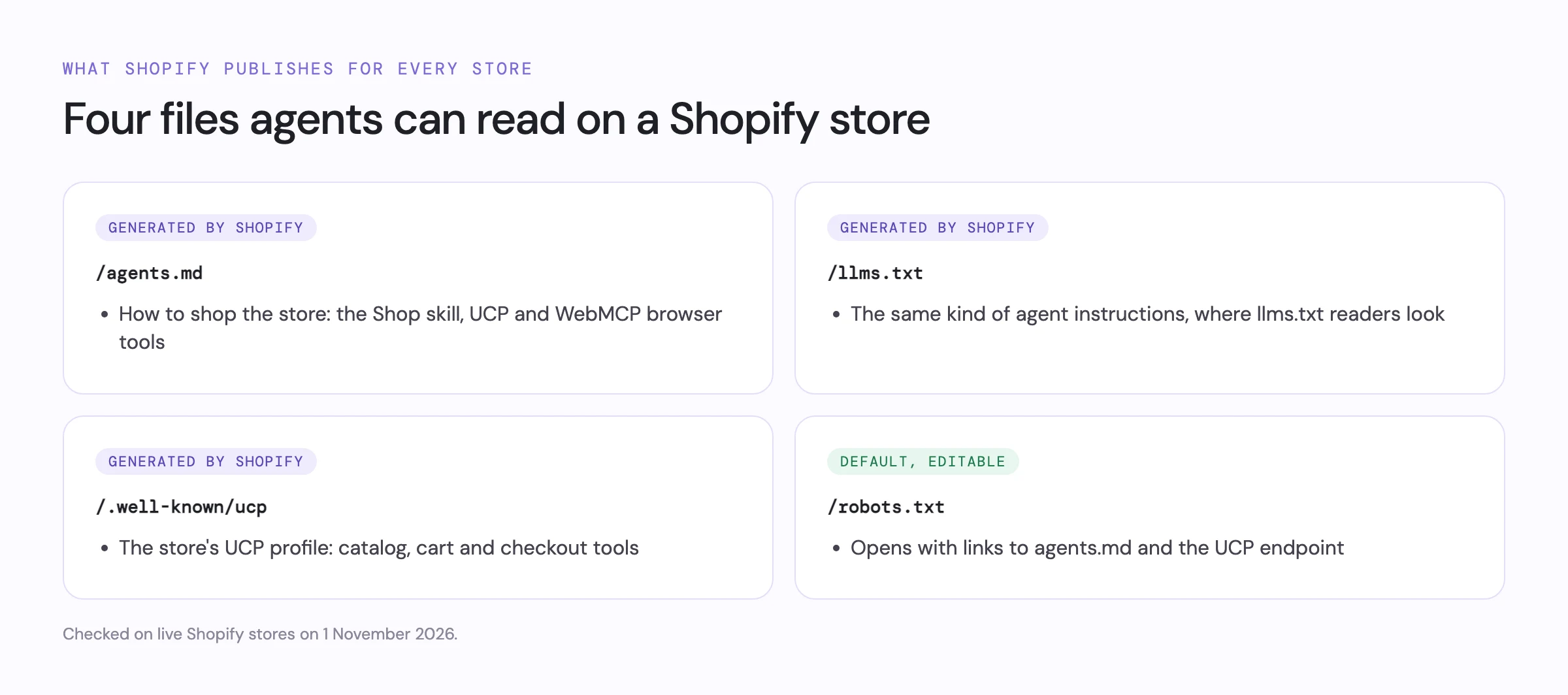
We checked live Shopify stores on 1 November 2026. Each served:
/agents.md | Agent instructions generated by Shopify: how to shop the store through the Shop skill, the Universal Commerce Protocol (UCP) and WebMCP browser tools. |
|---|---|
/llms.txt | The same kind of agent instructions, at the address llms.txt readers look for. |
/.well-known/ucp | The store's UCP profile, which points agents to its catalog, cart and checkout tools. |
/robots.txt | Opens with comments that link to agents.md and the UCP endpoint (see the robots.txt guide). |
Shopify generates these files. We haven't found a supported way to edit them, and Shopify's developer documentation doesn't describe one as of November 2026.
Do AI shopping agents read them?
A few AI tools read llms.txt; shopping agents mostly don't yet. Most agents still find products by searching and reading product pages, and some call a store's UCP tools directly. So these files help agents that look for them, but they don't replace complete product pages.
What matters more: product data agents actually get
When an agent asks a Shopify store for a product through UCP, it gets the title, the description, the price, the variants with their availability, options, images, category, collections and tags. In our tests in October 2026 it didn't get metafields, barcodes, brand or ratings. So:
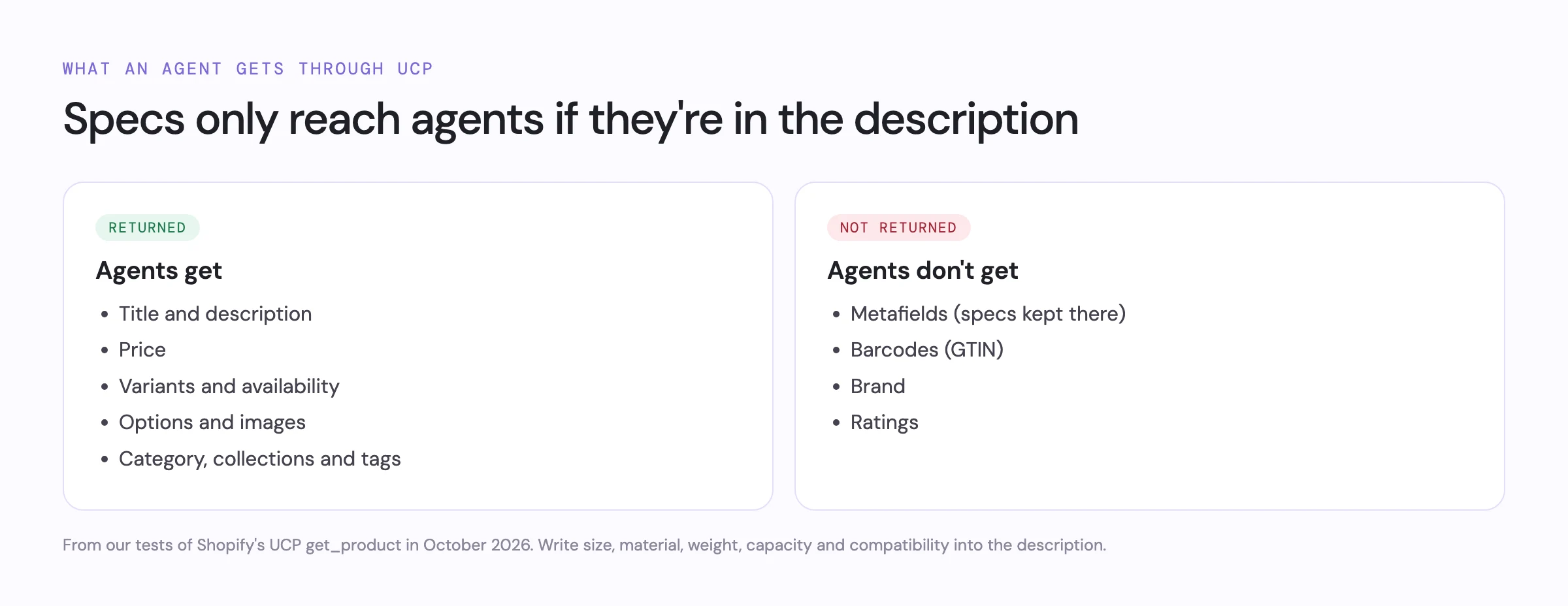
- Write the key specs into the description (size, material, weight, capacity, compatibility) as a short list, not only in tabs or metafields.
- Keep the description factual. Agents answer shoppers' questions from it.
- Keep structured data complete on the product page for the agents that read pages: price, stock, barcode (GTIN), brand and rating. The readiness checklist covers each one.
If your store isn't on Shopify
You can publish your own llms.txt: a Markdown file at /llms.txt with your store's name, a one-paragraph
summary, and links to your main collections, shipping and returns policies and contact page. It's cheap to add, but don't
expect it to replace product data. Scelto's own llms.txt is an example.
Check your store
The free agent check notes whether a store publishes llms.txt, agents.md and a UCP profile, and tests the product data agents read. It works on any store platform.
Questions
Do I need to create an llms.txt for my Shopify store?
No. As of November 2026 Shopify serves /llms.txt and /agents.md for every online store. Few shopping agents read llms.txt yet, so your product data matters more.
Can I edit Shopify's agents.md or llms.txt?
We haven't found a supported way, and Shopify's developer documentation doesn't describe one as of November 2026. Shopify generates both files.
What is UCP?
The Universal Commerce Protocol: an interface that lets agents search a store's catalog, build a cart and check out without reading its pages. Shopify stores publish a UCP profile at /.well-known/ucp.